Atmospheric Science
Layers of Earth’s Atmosphere
A protective, multi-layered envelope of gases held close by gravity, defined by how temperature changes with altitude.
The Importance of Earth’s Atmosphere
The atmosphere is essential for life on Earth because it:
- Sustains Life: It contains the breathable air (primarily nitrogen and oxygen) and water vapor necessary for living organisms and the water cycle.
- Regulates Climate: It traps heat through the natural greenhouse effect, moderating the planet’s temperature and preventing extreme fluctuations like those seen on the Moon.
- Provides Protection: It shields the surface from harmful solar radiation (UV rays) and protects against the impact of most extraterrestrial objects (meteors).
Five Layers, Ground to Space
From the ground up, the atmosphere is divided into the Troposphere, Stratosphere, Mesosphere, Thermosphere, and Exosphere.
Troposphere Greek tropos, “turning”
- Temperature Profile: Temperature decreases with altitude (lapse rate) because the ground heats the air from below.
- Mass & Density: Densest layer; contains about 75–80% of the atmosphere’s total mass and almost all water vapor.
- Events: Nearly all weather (clouds, rain, storms) occurs here due to vertical air movement (convection).
Stratosphere Latin stratum, “layer”
- Temperature Profile: Temperature increases with altitude due to absorption of UV radiation.
- Ozone Layer: Contains the Ozone Layer (O₃), which absorbs most of the Sun’s harmful ultraviolet (UV) radiation, protecting life on Earth.
- Events: Calm and cloud-free; the lower stratosphere is ideal for high-altitude jet travel to avoid turbulence.
Mesosphere Greek mesos, “middle”
- Temperature Profile: Temperature drops with altitude, reaching the coldest temperatures in the atmosphere (around –90°C) at the mesopause.
- Events: Meteors (shooting stars) burn up here due to friction with gas molecules, protecting lower layers.
Thermosphere Greek thermos, “heat”
- Temperature Profile: Temperature rises sharply with altitude, reaching thousands of degrees Celsius.
- Note on Heat: Air is extremely thin, so despite high molecular energy, a thermometer would still read freezing cold.
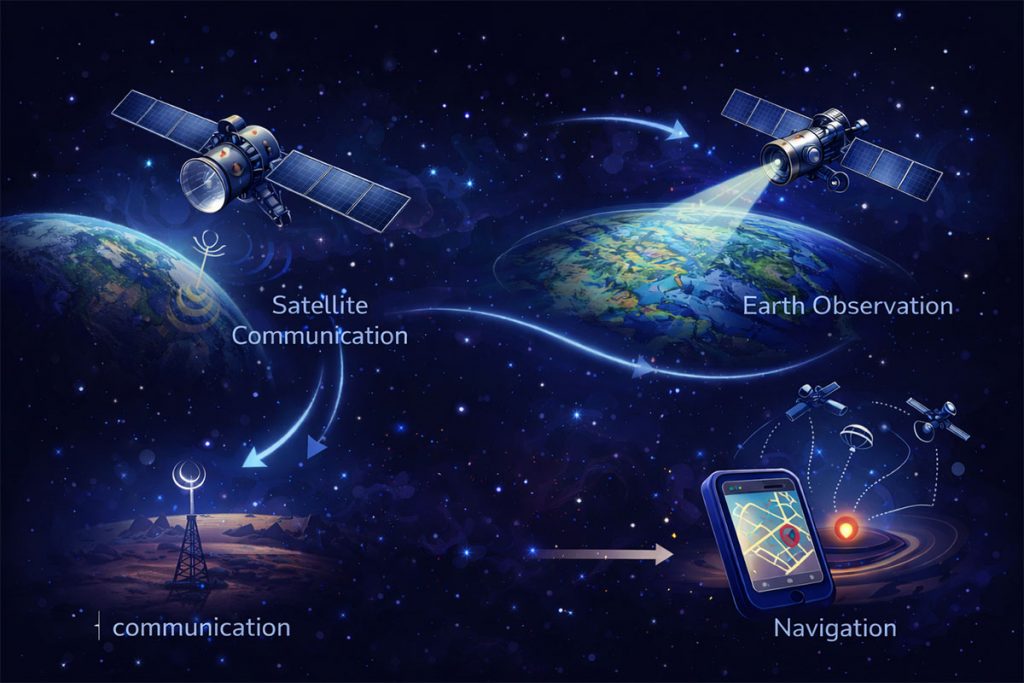
- Ionosphere: Solar radiation creates charged particles (ions) here, enabling auroras (Northern & Southern Lights) and the reflection of radio waves for long-distance communication.
- Orbit: The International Space Station (ISS) and many satellites orbit within this layer.
Exosphere Greek exo, “outside”
- Density: Extremely thin, made mostly of hydrogen and helium atoms.
- Boundary: Outermost layer, gradually merging into outer space.
- Events: Gas particles are so far apart that some escape Earth’s gravity and drift into space.