Black Hole
Regions of space where gravity is so intense that nothing—not even light—can escape their grasp.
Black holes are not empty voids, but a colossal amount of mass packed into an extremely tiny volume, representing the ultimate triumph of gravity.
Defining Characteristics
The Singularity
The theoretical center of a black hole where all of the object’s mass is concentrated. At this point, the density is infinite, and the laws of physics as we currently understand them completely break down — a point of infinite spacetime curvature.
The Event Horizon
The Point of No Return: the boundary surrounding the singularity, defined as the distance at which the escape velocity required to leave the black hole just exceeds the speed of light. Irreversible: once an object or particle crosses the event horizon, it is irrevocably falling toward the singularity — no information, matter, or light can travel back across this boundary.
The Schwarzschild Radius
The radius of the event horizon, directly proportional to the mass of the black hole.
Types of Black Holes
Black holes are generally classified by their mass, which is directly related to how they form.
Stellar-Mass
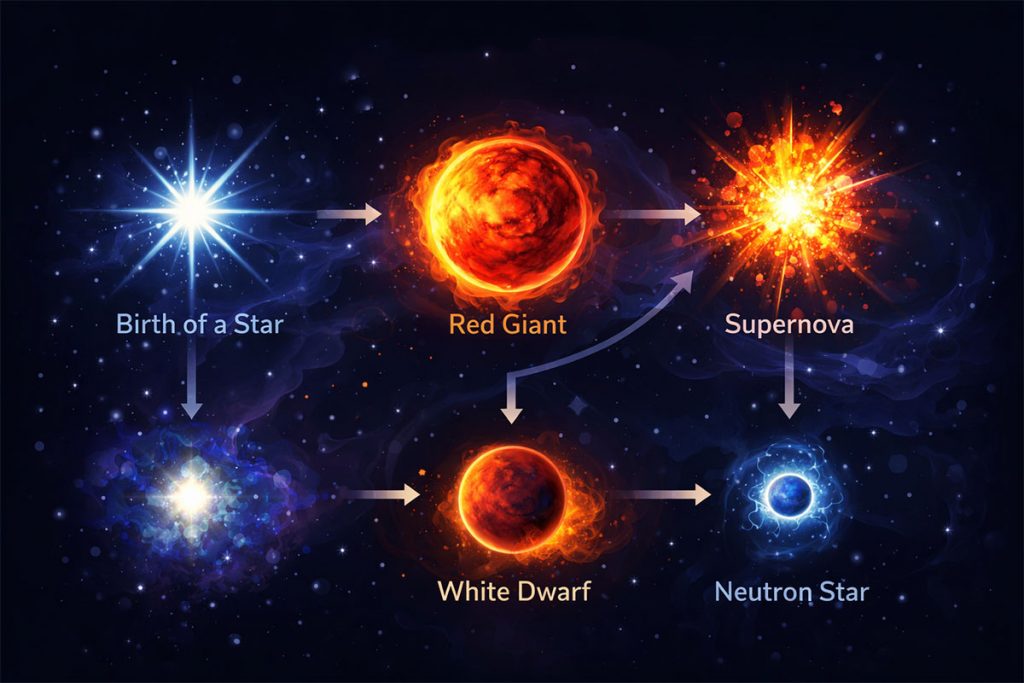
Formation: Core collapse of a single, massive star (typically 8 to 20 times the mass of our Sun) in a supernova explosion. Mass: Typically 3 to 20 times the mass of the Sun — the most common type observed.
Supermassive (SMBH)
Formation: Still debated, but they likely grow by consuming vast amounts of gas and merging with other black holes. Mass: From a hundred thousand to billions of solar masses. Every major galaxy, including our Milky Way (which hosts Sagittarius A*), is believed to have an SMBH at its center.
Intermediate-Mass (IMBH)
Mass: From 100 to 100,000 solar masses. Theoretically predicted, with evidence slowly emerging that they may form in dense stellar clusters.
Primordial
Formation: Hypothetical black holes that could have formed moments after the Big Bang from density fluctuations in the early universe, not from stellar collapse.
How We Detect Them
Since black holes emit no light, they must be detected indirectly by observing their powerful influence on nearby matter.
- Accretion Disks: As matter (gas and dust) spirals toward the event horizon, it accelerates, heats up to millions of degrees, and forms a bright, rotating accretion disk. This superheated plasma emits intense X-rays, which telescopes can detect.
- Gravitational Lensing: The extreme gravity of a black hole warps the spacetime around it, bending light from objects behind it and acting like a gigantic, distorted lens.
- Gravitational Waves: The spiraling and merging of two black holes (or a black hole and a neutron star) create ripples in the fabric of spacetime itself, known as gravitational waves. These waves are detected by sensitive instruments like LIGO and Virgo.
- Stellar Orbits: Astronomers can observe the unusual, rapid orbits of stars around an unseen, massive object at a galaxy’s center, proving the presence of a Supermassive Black Hole.