Exploring Surfaces: How Do We See Other Worlds?
Some worlds allow direct contact; others can only be studied remotely. Each surface tells a unique story about the origin and evolution of the Solar System.
- Gas giants like Jupiter and Saturn do not have solid ground. What we see are cloud tops—vast, turbulent atmospheres thousands of kilometers thick. Any solid core, if it exists, lies far below, unreachable by current technology.
- Ice giants also hide their interiors beneath dense atmospheres and extreme pressures.
In these cases, scientists study atmospheric motion, gravity, and magnetic fields to infer what lies beneath.
Missions That Revealed These Worlds
Planetary surfaces are explored using orbiters, landers, rovers, and radar instruments.
Mars
Mars is a terrestrial planet with a solid surface made of rock and dust, similar in structure to Earth but much colder and drier.
Key Missions Timeline: 1965 Mariner 4 (first close-up images of the surface); 1976 Viking 1 & 2 (first successful landings); 1997 Pathfinder & Sojourner (first rover mission); 2004 Spirit & Opportunity (evidence of ancient water); 2012 Curiosity (studied habitability and organic chemistry); 2021 Perseverance (searching for signs of ancient life).
Why Mars Matters: Mars shows clear evidence of ancient rivers, lakes, and possibly oceans, making it one of the most important targets in the search for past life beyond Earth.
Earth
Earth is the only known world with stable liquid water on its surface and confirmed life. It serves as the reference point for all planetary studies.
Observation Systems: Earth-observing satellites since the 1960s, and the International Space Station since 1998.
Why Earth Matters: By understanding Earth’s surface, climate, and geology, scientists can better interpret what they observe on other planets.
Venus
Venus is similar in size to Earth but has an extremely dense atmosphere that traps heat, making its surface the hottest in the Solar System.
Key Missions Timeline: 1970 Venera 7 (first successful landing); 1975 Venera 9 & 10 (first surface photographs); 1990–1994 Magellan (radar mapping of the surface).
Why Venus Matters: Venus demonstrates how a planet similar to Earth can evolve in a dramatically different way due to atmospheric changes.
The Moon
The Moon is a rocky body that orbits Earth and has no atmosphere, preserving a record of early Solar System impacts.
Key Missions Timeline: 1959 Luna 3 (first images of the far side); 1969–1972 Apollo Missions (human landings and sample return); 2009 Lunar Reconnaissance Orbiter (high-resolution mapping).
Why the Moon Matters: The Moon helps scientists understand planetary formation and the early history of Earth itself.
Asteroids
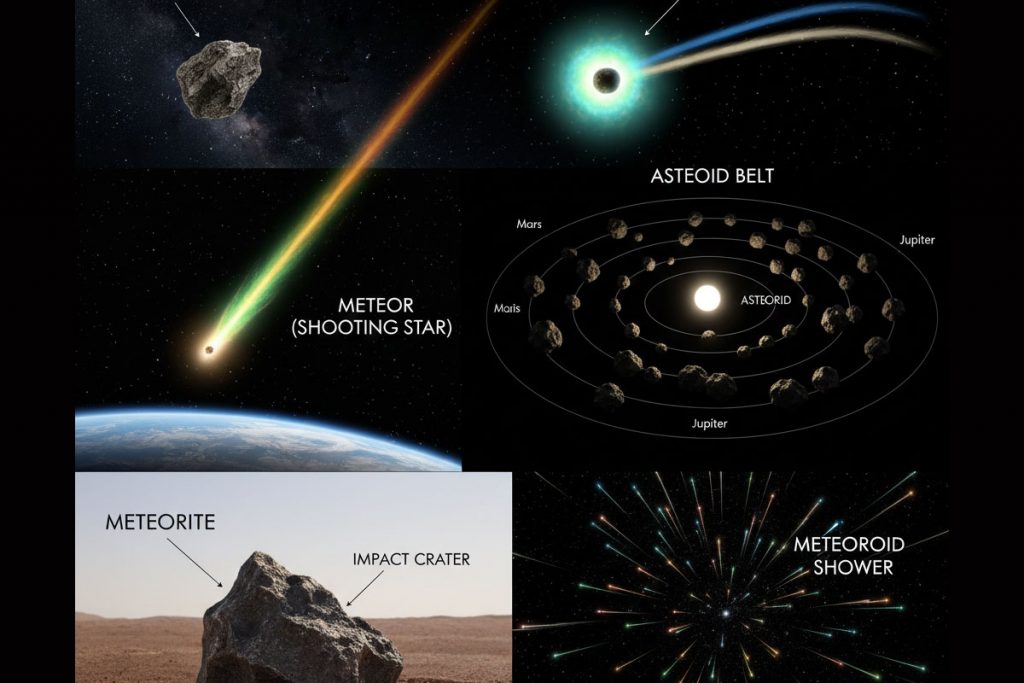
Asteroids are leftovers from the early Solar System, mostly found between Mars and Jupiter, though many travel closer to Earth.
Key Missions Timeline: 2001 NEAR Shoemaker (first asteroid landing); 2018 Hayabusa2 (sample return from Ryugu); 2023 OSIRIS-REx (sample return from Bennu).
Why Asteroids Matter: They contain pristine material from the Solar System’s birth and may have delivered water and organic molecules to Earth.
Titan
Titan is a thick-atmosphere moon larger than the planet Mercury. It is the only moon known to have stable liquids on its surface.
Key Missions Timeline: 2004 Cassini Orbiter (long-term study of Titan); 2005 Huygens Probe (first landing on Titan).
Why Titan Matters: Titan has rivers, lakes, and rain—made not of water, but of liquid methane and ethane—making it one of the most Earth-like worlds in behavior, though not in composition.
Why Studying Surfaces Matters
Understanding planetary surfaces helps answer some of humanity’s biggest questions:
- How did the Solar System form?
- Why did Earth become habitable while others did not?
- Where might life exist beyond Earth?
- How do planets change over time?
Surface features record billions of years of history—impacts from asteroids, ancient oceans, volcanic eruptions, and climate shifts. By comparing different worlds, scientists learn how universal physical laws create astonishingly diverse outcomes.
A Journey Still in Progress
What we know today is only a fraction of what remains to be discovered. Future missions will drill deeper, map more precisely, and explore worlds once thought unreachable. Some surfaces we see now may look very different as our tools improve.
Every image, measurement, and map brings us closer to understanding not only distant worlds, but also our own place among them.