Space History

Space Exploration Timeline

Fourteen milestones, from the first artificial satellite to the telescopes and lunar programs of today.

1957

First Artificial Satellite

In 1957, the Soviet Union launched Sputnik-1, the world’s first artificial satellite, into space. Sputnik was a small, metal sphere that traveled around the Earth and sent simple radio signals back to the ground. Although it was very small, its launch was a giant step for humanity.

Aim and Purpose

The main purpose of Sputnik-1 was to:

  • Test whether a man-made object could orbit the Earth
  • Study how radio signals travel through space
  • Learn how space affects objects outside Earth’s atmosphere

Why It Was Important

Before Sputnik, no one knew for sure if objects could stay in orbit without falling back to Earth. Sputnik proved that:

  • Rockets were powerful enough to reach space
  • Satellites could travel around Earth continuously
  • Humans could begin exploring space beyond our planet

Impact on the World

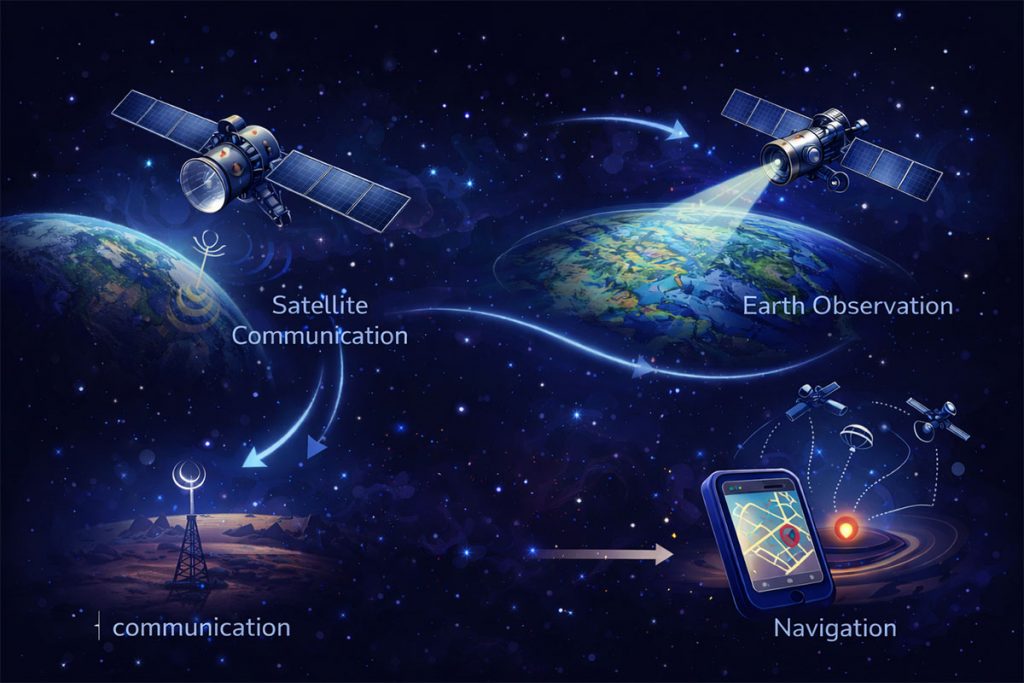
Sputnik-1 marked the beginning of the Space Age. It encouraged countries and scientists to develop weather and communication satellites, create navigation systems such as GPS, and plan future space missions, including human spaceflight. This historic launch helped shape modern space technology and changed the way people understand the universe.
1961

First Human in Space

In 1961, a brave pilot named Yuri Gagarin became the first human to travel into space. He flew aboard a spacecraft called Vostok-1, which was launched by the Soviet Union. As the rocket lifted off, Yuri Gagarin left Earth and traveled high above the planet, becoming the first person to see Earth from space.

What Happened During the Mission

Vostok-1 went all the way around the Earth one complete time, which is called an orbit. The entire journey took less than two hours, but it was enough to make history. During the flight, Yuri experienced weightlessness, meaning he floated instead of standing or sitting.

Aim and Purpose

The main goals of this mission were to find out if a human could survive in space, learn how the human body reacts to weightlessness, and test whether a person could control a spacecraft.

Why This Was Important

Before this mission, no one knew if humans could breathe, move, or think clearly in space. Yuri Gagarin’s successful flight showed that humans can live and work in space, space travel is possible for people and not just machines, and future missions with astronauts could be planned.

Impact on Space Exploration

This historic journey opened the door for longer space missions and eventually led to astronauts traveling to the Moon and living on space stations. Yuri Gagarin’s flight changed human history and showed that exploring space was no longer just a dream.

1969

First Humans on the Moon

In 1969, people dreamed of visiting the Moon, which is Earth’s closest neighbor in space. That dream came true with a mission called Apollo 11, sent by NASA (the space agency of the United States).

Three astronauts went on this journey: Neil Armstrong, Buzz Aldrin, and Michael Collins. The spaceship traveled all the way to the Moon, which is about 240,000 miles (386,000 kilometers) away from Earth.

When they reached the Moon, Neil Armstrong became the first person to step on its surface, saying the famous words: “That’s one small step for man, one giant leap for mankind.” Soon after, Buzz Aldrin joined him. They walked on the Moon, looked around, collected rocks, and took pictures.

This was an amazing achievement because it showed that humans could travel to another world, not just imagine it. It required lots of teamwork, science, and technology—from building rockets that could leave Earth to making special space suits that let astronauts survive on the Moon.

The Moon landing inspired millions of people around the world and proved that dreams can come true if people work hard and never give up.

1971

First Space Station

In 1971, people took another giant step in space exploration. The Soviet Union launched Salyut-1, the world’s first space station.

A space station is like a small house that floats in space. Astronauts can live, eat, sleep, and work there while orbiting the Earth. Salyut-1 was the very first of its kind, and it showed that humans could stay in space for longer periods of time, not just a few hours or days.

Astronauts inside Salyut-1 did experiments, studied how the human body reacts in space, and tested new technologies for future space missions. This was important because it helped scientists learn how people could live and work in space safely for weeks or even months.

Salyut-1 was the beginning of space stations—proving that humans can adapt to life far above the Earth.

1981

First Space Shuttle Flight

In 1981, NASA made history again by launching the Space Shuttle Columbia on its very first flight, called STS-1. The Space Shuttle was special because it was reusable, meaning it could fly to space, come back to Earth, and then fly again—unlike rockets that could only be used once before.

The Space Shuttle was like a space airplane. It could carry astronauts and large cargo into orbit around Earth. This meant scientists could send satellites into space, do experiments, and even help build the International Space Station (ISS).

Astronauts aboard the shuttle could live and work in space for days or weeks. The shuttle had a big cargo bay in the middle where equipment, satellites, and other tools could be carried to space. It could also return heavy items safely back to Earth.

The Space Shuttle program was important because it showed that humans could travel to space many times in the same vehicle, making space travel faster, cheaper, and more practical. Over the next 30 years, shuttles helped build the ISS, launch telescopes like Hubble, and explore space in ways that weren’t possible before.

1990

Hubble Space Telescope

In 1990, scientists sent a very special telescope into space called the Hubble Space Telescope. Unlike telescopes on Earth, Hubble floats high above the atmosphere, so it can see the universe more clearly—without the blurring caused by Earth’s air.

Hubble is like a powerful space camera. It can take detailed pictures of stars, planets, galaxies, and other cosmic objects that could never be seen in such detail from Earth. With Hubble, astronomers have discovered how fast the universe is expanding, found new planets, and learned more about black holes.

Because it orbits the Earth, Hubble has been working for decades, sending back thousands of images that continue to inform scientists and the public. It functions as a window into the farthest corners of space, helping researchers understand how the universe began, how stars are born, and what galaxies look like billions of light-years away.

1998

International Space Station (ISS)

In 1998, countries from around the world started building a permanent space laboratory in orbit called the International Space Station (ISS). The ISS allows astronauts to conduct scientific research, test new technologies, and study the effects of long-term spaceflight on the human body.

The project represents a partnership among 15 countries, including the United States, Russia, Canada, Japan, Belgium, Denmark, France, Germany, Italy, Netherlands, Norway, Spain, Sweden, Switzerland, and the United Kingdom. Through their space agencies—NASA, Roscosmos, JAXA, CSA, and ESA—these nations contributed modules, research equipment, and technical expertise to build and maintain the station.

How Did They Do It? The ISS wasn’t launched all at once. Instead, pieces were sent into orbit bit by bit, and astronauts and robots helped connect them together. Over the years, countries sent up living modules for astronauts, science labs, solar panels for power, and docking ports for spacecraft.

Once the ISS was complete, astronauts began living there continuously since 2000.

2001

First Space Tourist

In 2001, Dennis Tito, an American businessman, became the first private citizen to travel to space. Unlike astronauts who train for years as part of a space agency, Tito was a space tourist—someone who paid to go into space for the experience.

He traveled aboard a Russian spacecraft called Soyuz TM-32, which took him to the International Space Station (ISS). Tito spent several days living and working alongside professional astronauts, experiencing life in orbit for the first time as a private traveler.

This journey was historic because it opened the door for commercial human spaceflight. It showed that space travel wasn’t just for government astronauts anymore—private citizens could also visit space if they had the means and training.

Dennis Tito’s trip helped stimulate the idea of space tourism, and since then, other private individuals and companies have worked to make space travel accessible for more people.

2004

First Private Human Spaceflight

In 2004, a major milestone in space exploration was achieved when SpaceShipOne, developed by a private company, successfully completed the first privately funded human spaceflight. This historic flight marked the first time a spacecraft designed and built entirely by a private company carried humans into space, without direct government operation.

Piloted by Mike Melvill and later Brian Binnie, SpaceShipOne reached suborbital space, briefly crossing the boundary of space before safely returning to Earth. The mission demonstrated that private companies could design, build, and operate spacecraft, paving the way for commercial space ventures, space tourism, and the modern era of private-sector involvement in space exploration.

SpaceShipOne’s success also won the Ansari X Prize, a competition designed to encourage private innovation in spaceflight. This achievement proved that space was no longer limited to government agencies and set the stage for companies like SpaceX, Blue Origin, and Virgin Galactic to expand human presence in space.

2012

First Commercial Cargo Mission

In 2012, SpaceX’s Dragon spacecraft successfully completed the first commercial mission to deliver cargo to the International Space Station (ISS). This was the first time a privately developed and operated spacecraft transported supplies to astronauts in orbit, marking a new era in space operations.

The mission, known as CRS-1 (Commercial Resupply Services 1), carried essential items such as food, water, scientific equipment, and experiments for the crew aboard the ISS. Dragon was designed to autonomously dock with the station, unload cargo, and safely return to Earth, demonstrating a level of reliability and precision previously managed only by government-operated spacecraft.

This achievement transformed space logistics by showing that private companies could play a crucial role in maintaining and supplying space stations, reducing reliance on traditional government launch systems and opening doors for commercial space operations.

2021

China Space Station

In 2021, China took a major step forward in its space program with the launch of the core module of the Tiangong space station, marking the beginning of a new, independently developed orbital outpost. The word Tiangong means “Heavenly Palace,” and this modular station is designed to support long-duration human habitation, scientific research, and technological development in space.

The first piece of the station, called Tianhe (“Harmony of Heavens”), was launched on April 29, 2021. This core module houses the living quarters, life-support systems, and control systems that allow astronauts—known in China as taikonauts—to live and work in orbit.

Following the initial launch, China continued assembling Tiangong in orbit by adding laboratory modules: Wentian (“Quest for the Heavens”), launched in July 2022, and Mengtian (“Dreaming of the Heavens”), launched in October 2022.

The first crewed mission to Tiangong arrived in June 2021 aboard a Shenzhou 12 spacecraft, when only the Tianhe core was in orbit. That crew spent about 90 days aboard the station—the longest stay by Chinese astronauts at that time.

Tiangong is much smaller than the International Space Station (ISS)—roughly 20% of the ISS’s mass—but it is a fully functional orbiting research laboratory capable of hosting a crew of three for extended missions. China aims to keep the station continuously inhabited for at least a decade.

2021

First All-Civilian Spaceflight — SpaceX Inspiration4

In September 2021, SpaceX launched the first all-civilian spaceflight, called Inspiration4. Unlike traditional missions, there were no professional astronauts on board—the crew consisted entirely of private citizens from different walks of life, trained specifically for this mission.

The flight used a Crew Dragon spacecraft launched atop a Falcon 9 rocket from NASA’s Kennedy Space Center. The four-person crew orbited the Earth for three days, reaching an altitude higher than the International Space Station. During their mission, they conducted experiments in human health, space science, and Earth observation.

This mission marked a new era in space travel, demonstrating that private companies like SpaceX could carry civilians safely into orbit, expanding the possibilities for space tourism.

2022

James Webb Space Telescope

In 2022, the James Webb Space Telescope (JWST) began its scientific operations, marking a significant milestone in astronomy and space exploration. Often called the successor to the Hubble Space Telescope, JWST is the most powerful space telescope built to date, designed to look farther into the universe than any previous telescope.

JWST observes in infrared light, allowing it to see through cosmic dust clouds and detect the faint light of distant galaxies formed billions of years ago. By doing so, it provides astronomers with an unprecedented view of the early universe, helping to answer fundamental questions about how galaxies, stars, and planetary systems formed and evolved.

One of JWST’s key goals is to study exoplanets—planets orbiting stars beyond our solar system. Its advanced instruments can analyze the atmospheres of these distant worlds, searching for signs of water, chemical compositions, and conditions that could make them potentially habitable.

Launched on December 25, 2021, JWST traveled to a stable orbit 1.5 million kilometers from Earth at the second Lagrange point (L2), far beyond the Moon. After unfolding its sunshield and mirrors, it completed calibration and began sending back high-resolution images and data in 2022. JWST represents a global collaboration led by NASA, with significant contributions from the European Space Agency (ESA) and the Canadian Space Agency (CSA).

2022

Lunar Exploration Programs — Artemis & ILRS

Artemis Program

The Artemis program is a major lunar exploration initiative led by NASA with the goal of returning humans to the Moon and establishing a sustained presence there, while laying the groundwork for future missions to Mars.

Key Goals and Features:

  • Return humans to the Moon: Artemis aims to land astronauts on the lunar surface for the first time since the Apollo missions of the 1960s–70s, including sending the first woman and first person of color to walk on the Moon’s south pole.
  • Long-term exploration: Unlike Apollo, Artemis seeks sustained exploration and research with repeated crewed missions and infrastructure.
  • Partnerships: The program is international, involving space agencies like ESA (Europe), JAXA (Japan), CSA (Canada), and others collaborating on spacecraft, landers, and technology.
  • Technology and science: Artemis missions will test new systems in lunar orbit and on the surface, study lunar water ice, and conduct science that prepares for Mars exploration.

Artemis began with Artemis I (an uncrewed test mission in 2022), followed by Artemis II (a crewed lunar flyby planned for 2026) and Artemis III, which will attempt a Moon landing.

International Lunar Research Station (ILRS)

The International Lunar Research Station (ILRS) is a planned lunar base initiative led by China’s CNSA (China National Space Administration) and Roscosmos (Russia), designed to create a long-term scientific research facility on or near the Moon.

The ILRS aims to build a multi-purpose lunar research base that supports scientific experimentation, exploration, lunar resource utilization, and future crewed missions, covering research in lunar geology, space environment studies, astronomy, biology, and in-situ resource use.

Structure and Phases:

  • Reconnaissance (2021–2025): Early robotic missions gather data and test technologies to support future construction.
  • Construction (2026–2035): Infrastructure modules, research facilities, and autonomous systems are assembled on the lunar surface and in orbit.
  • Utilization (from 2036): The completed station supports scientific exploration and will host periodic human missions.

Although led by China and Russia, ILRS is intended to be open to global partners. Countries including Pakistan, South Africa, Senegal, Belarus, Venezuela, Azerbaijan, Egypt, and others have signed cooperation agreements or expressed interest. Some countries are contributing scientific payloads that will fly on precursor missions like Chang’e 7 and Chang’e 8, which help prepare the site and technology for the station.

Back to Space Gallery