Birth and Death of Stars
Stellar evolution describes the changes a star undergoes over time, driven entirely by its initial mass and the forces of gravity and nuclear fusion.
The entire universe is a product of this cycle: dying stars disperse the heavy elements that fuel the formation of new stars, planets, and even life itself.
The Birth of a Star
The journey of every star begins in the same place: a vast, cold region of space.
- Nebula (Giant Gas Cloud): Stars are born in nebulae, which are immense, sprawling clouds of gas (mostly hydrogen and helium) and dust. These are often called “stellar nurseries”.
- Gravitational Collapse: Disturbances, such as shockwaves from a nearby supernova, can cause denser pockets within the nebula to collapse under their own gravity.
- Protostar: As the cloud contracts, friction and compression cause the material to heat up, forming a dense, warm core known as a protostar. This pre-star phase continues to gather mass from the surrounding cloud.
The Stable Life (Main Sequence)
A star is truly “born” when its core temperature reaches millions of degrees Kelvin, igniting nuclear fusion.
- Nuclear Fusion: At a core temperature of about 15 million degrees Celsius, the immense pressure forces hydrogen atoms to fuse and combine, forming helium. This reaction releases a colossal amount of energy, following Einstein’s mass-energy equivalence, E=mc².
- Main Sequence: The energy released by fusion creates an outward pressure that perfectly balances the inward pull of gravity. This stable state is called hydrostatic equilibrium, and the star enters the Main Sequence. This is the longest phase of a star’s life, typically lasting about 90% of its total lifespan (our Sun is currently midway through this stage).
- Mass Determines Lifetime: A star’s initial mass is the most important factor determining its lifespan.
- High-Mass Stars burn their fuel much faster due to greater core pressure, living for only a few million years.
- Low-Mass Stars (like the Sun) burn slowly and efficiently, shining for billions of years.
The Death of a Star: Two Fates
Once a star exhausts the hydrogen fuel in its core, it loses its hydrostatic equilibrium and leaves the Main Sequence. From here, its death is dictated by its initial mass.
Low-Mass Stars (up to ~8 Solar Masses)
Core hydrogen is depleted. The core contracts and heats up, causing the outer layers to swell dramatically and cool (turning red). Helium fusion begins in the core, creating carbon.
Core: Fusing HeliumAfter helium is exhausted, the star becomes unstable and ejects its outer layers into space, forming an expanding shell of gas.
Core: CollapsingThe small, dense, and extremely hot core that remains is composed primarily of carbon and oxygen. It no longer undergoes fusion but slowly cools down over billions of years.
Stable, cooling coreAfter immense time, the white dwarf will cool completely, ceasing to emit light and becoming a theoretical stellar remnant.
Cold, dark remnantHigh-Mass Stars (8+ Solar Masses)
The massive star expands into a vast supergiant, many times the size of a red giant. Its core temperature is high enough to fuse progressively heavier elements (helium, carbon, oxygen, neon, silicon) in concentric shells.
Core: Fusing multiple elementsThis chain of fusion stops when the core turns into iron (Fe). Fusing iron absorbs energy rather than releasing it, causing the outward pressure to cease instantly.
Core: IronWithout any outward support, the star’s immense gravity causes the core to collapse catastrophically in a fraction of a second. The resulting compression creates a massive shockwave that blows the outer layers of the star into space—a spectacular explosion called a supernova. The force of this explosion is what creates all elements heavier than iron, such as gold and uranium.
Core: ImplodingIf the remaining core mass is between 1.4 and about 3 solar masses, gravity crushes protons and electrons together to form a super-dense ball of neutrons, called a neutron star (only 10–20 km wide, but incredibly massive).
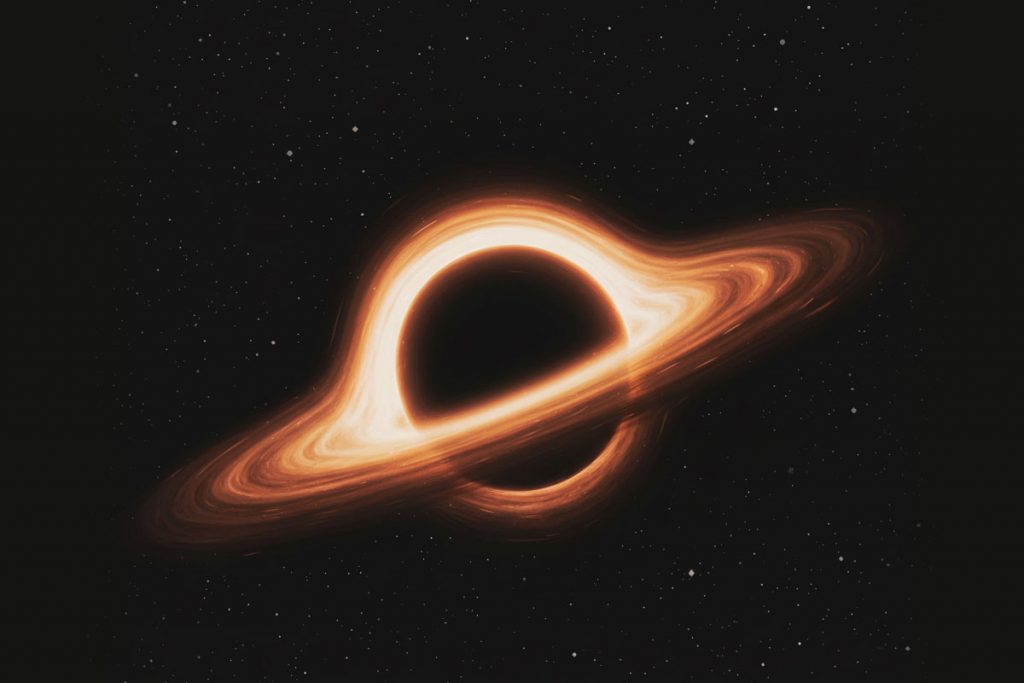
Collapsed coreIf the remaining core mass is greater than about 3 solar masses, the force of gravity is so overwhelming that nothing—not even light—can escape. This forms a black hole.
SingularityThe remnants of dying stars (planetary nebulae and supernova remnants) enrich the interstellar medium with heavy elements, providing the raw material for the next generation of stars and planetary systems, continuing the cosmic cycle.